Last night, I had to make a screencast for a project I’ve been working on. I find this sort of thing really challenging. I’m not sure whether it’s because I’m self-conscious or because I’m an introvert or if it’s just human, but listening to my own voice is worse than nails on a chalkboard. And because of that it’s extremely hard to evaluate how well or how badly I’m speaking.
But in this case, I found a really useful hack: After each recording take, I would paste the transcript into a Claude session. The session had all the context about what I was trying to achieve, and the rough outline of the script. It was giving me incredibly useful feedback.
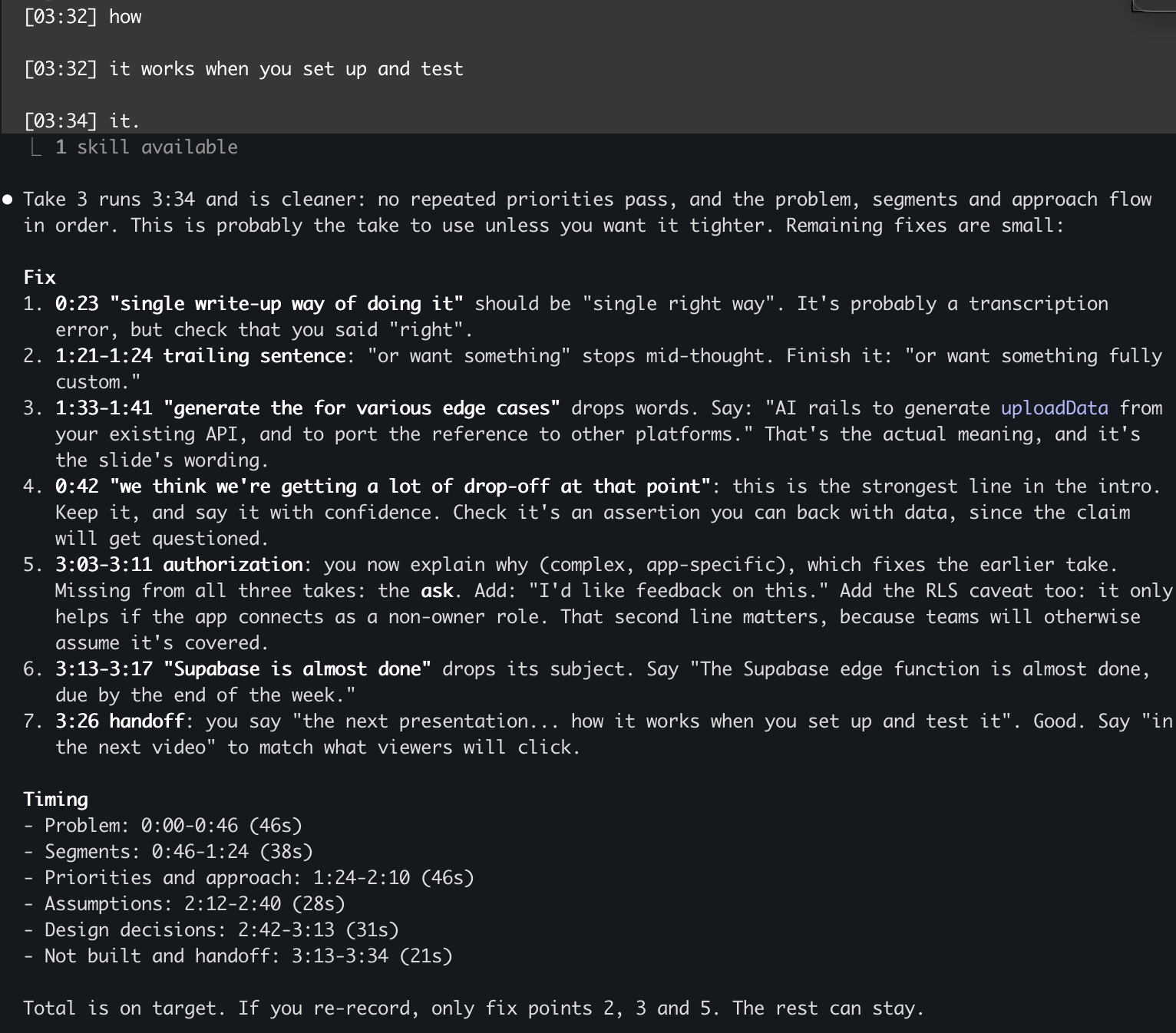
And so, in three or four takes, I managed to go from something that was objectively terrible to a recording that I was reasonably happy with.
And this made me realize again the massive value that I get from using my LLM as a coach. This isn’t a particularly new idea. But what’s undervalued is the compounding effect of how we integrate that coaching into every single interaction.
Being shaped - redux
I’m a big fan of pointing at McLuhan and his thesis that we shape our tools and thereafter they shape us. By deciding how we use the tools, we can choose to either get shaped into the little blobby people from WALL-E who are so overly dependent on their robots that they can’t even get out of their chairs, or whether we use our LLMs to become smarter and sharper over time, as an inevitable result of how we use them.

I’ve written about this before, in the context of how we write code and build, but I think there’s a broader application across all domains. You can use this tool as a crutch, or you can use it as a springboard. And the strongest springboard effect is when it coaches you on every interaction.
The reality is that no human will give you this density or quality of feedback, regardless of how nicely you ask them. The social cost is simply too high. From humans, you need a balance of positive and negative interactions to maintain a working relationship. Someone who’s giving you this amount of critical feedback will be tough to deal with. I don’t find that this same principle applies to my AI interactions - I’m quite happy to deal with a Claude who ruthlessly dismisses my bad ideas and weak thinking without feeling hurt and judged. Perhaps this is a side effect of the uncanny valley that LLMs are in, perhaps it’s due to the medium (words on a screen/left brain instead of organic right-brain interactions). Either way, I can get continual coaching from Claude without it grinding me down, unlike what it would be like to get all that feedback from a human.
All the edtech people are talking about Bloom’s 2 Sigma Problem: the power of one-on-one coaching and how useful that is in educating school-age kids and students. But I’ve seen little discussion about how to apply that to your life as a “mature” adult. Maybe we’re still so bedazzled by what this tool can make FOR us, that we are completely forgetting what it can make OF us. Even in our supposed maturity, we can still continually improve if we create the right environment. And one-on-one coaching is a big part of that environment.
The uncomfortable system prompt
I’ve set up my Claude system prompt to critically evaluate every question that I ask, think about how I’ve answered the question, whether the question is worth asking, and guide me on the context of the question as opposed to just answering the question directly.
When there is opportunity to coach me or help me learn then use that opportunity. I don’t just want answers to my prompts and questions - I want feedback on how to get better as a person and think better about what those prompts should have been
Here’s a typical output example, when Claude was helping me review a packing list for a camping trip:
Your checklist is done, with your original items, everything I flagged, braai tongs and AAA batteries. I grouped the water, fuel and fire-starting items under NB since they’re the ones that can ruin the trip. One coaching point: you wrote the list in categories but never asked “what does each person need for 24 hours?” Running through food, water, warmth, shelter, light and fire as a quick pass would have caught most of those gaps yourself.
My wife has set up her AI based on this, to answer most of her questions in a sort of a Socratic style of mirroring her questions with its own questions to lead her to a conclusion herself rather than just spoon feed her some information. Sometimes it takes her an hour to get to an answer that Claude could have given her immediately, but when she gets the answer, she understands it deeply, rather than being able to parrot the surface.
The everything coach
The thing that I’m slowly internalizing is that this is applicable across almost every domain in my life. I’m using this for my writing. I’ve used it to evaluate screencasts. I’ve used it to evaluate DD reports. I’ve gotten feedback on my parenting style. LLMs are incredibly broad generalists and even where they have gaps they can research at hyper speed and synthesize. So you can get feedback and coaching on literally anything, in almost any format. Imagine telling someone a few years ago that you could have a polymath genius tutor at your disposal 24 hours a day?
This new tool that we’ve been given really presents us with a choice. We can use it in a way that is comfortable and easy and effortless, or we can use it in a way that challenges us and makes us incrementally better with every interaction.